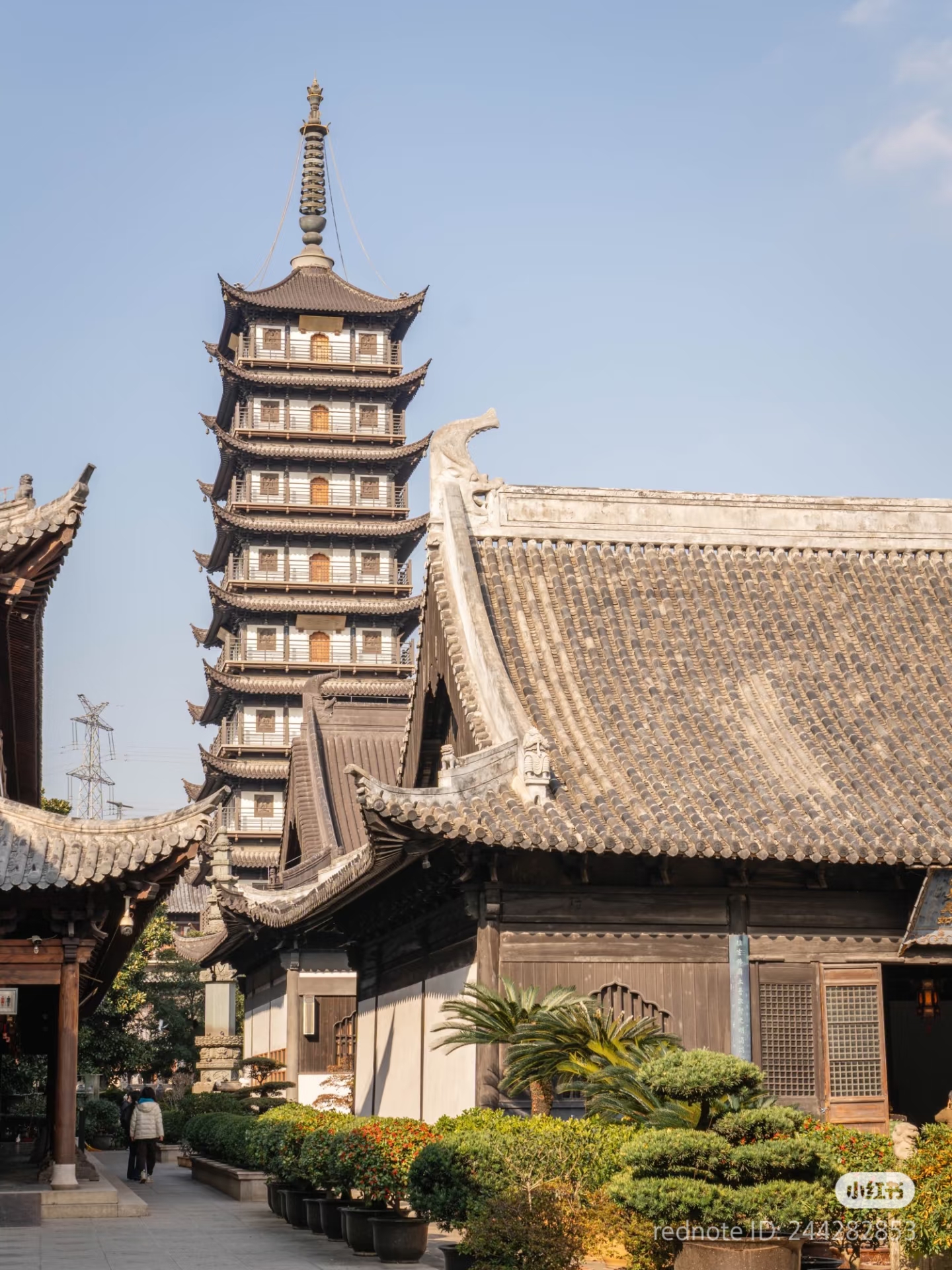
Much of Chinese history can be understood with the concept of ‘Mandate of Heaven’: when an emperor or dynasty had the Mandate of Heaven he was accepted as being divinely appointed. And when his actions, or the circumstances of the empire waned he could be thought of as no longer having the Mandate of Heaven, and hence a valid target to be overthrown.
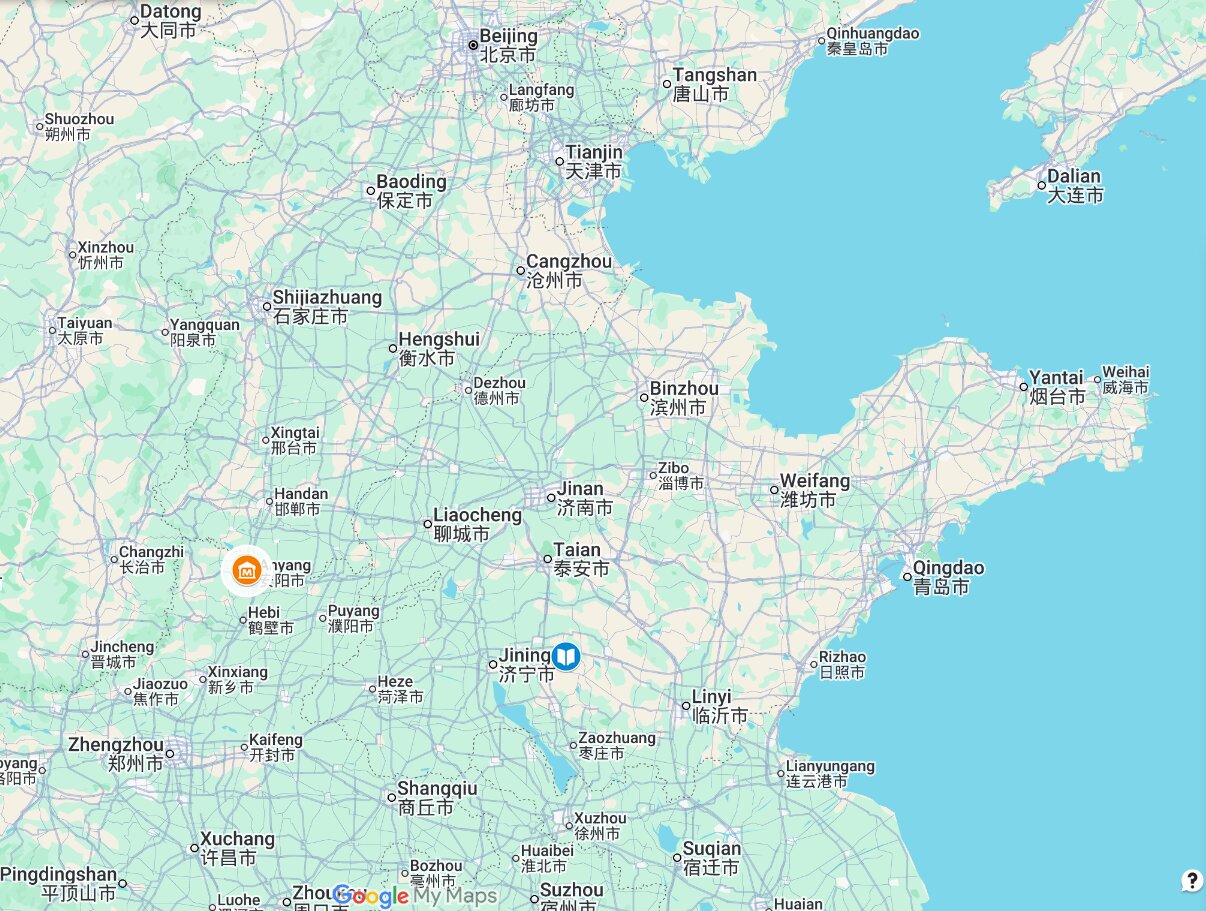
The Shang dynasty, also known as the Yin dynasty, was a Chinese royal dynasty that ruled in the Yellow River valley during the 2nd millennium BC, succeeding the Xia dynasty and followed by the Western Zhou dynasty.
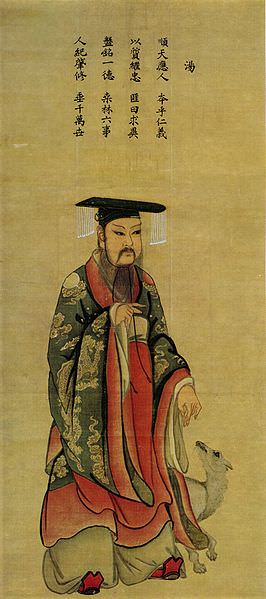
The dynasty was founded 13 generations after Xie, when Xie’s descendant, Tang, overthrew Jie, the impious and cruel final Xia ruler in the Battle of Mingtiao.
Tang ruled Shang – one of the many kingdoms under the Xia dynasty, for 17 years. During Jie‘s reign, Shang grew in power, initially at the expense of Xia’s other vassals. Jie was the last king of the Xia dynasty.
Tang progressively captured other kingdoms of the Xia empire and gained their loyalty. In part because Jie was regarded as a tyrant and oppressor. Tang treated his subjects kindly.
The Shang army fought against Jie’s Xia forces at the Battle of Mingtiao in a heavy thunderstorm and defeated them. With the exiling of Jie, Tang succeeded him as paramount King, inaugurating the Shang dynasty.
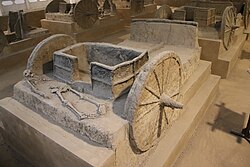
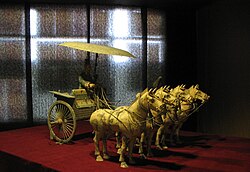
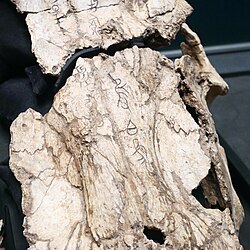
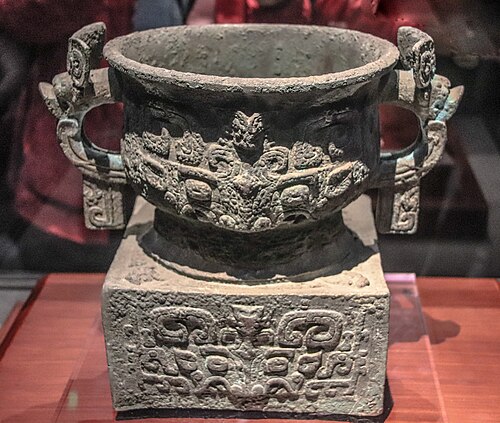
The Shang made many contributions to Chinese civilization, but four in particular define the dynasty: the invention of writing; the development of a stratified government; the advancement of bronze technology; and the use of the chariot and bronze weapons in warfare.
Tang’s reign was regarded as a good time by the Chinese. He lowered taxes and the conscription rate of soldiers. His influence spread to the Yellow River, and many outlying tribes, such as Di and Qiang, became vassal states.
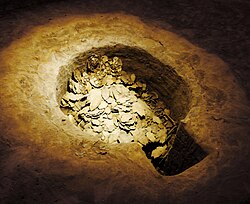
According to the Bamboo Annals, Tang built a palace called Xia She to memorialize the Xia dynasty. In the first five years of his reign, there was a constant drought. Tang ordered golden coins to be made and distributed to poor families who had been forced to sell their children because of the drought. It was intended for them to use this money to buy their children back. Tang had stockpiled around 10 years of resources during his reign over Predynastic Shang, which allowed his people to overcome the drought.
The dynasty consisted of heredity kings (29 in total), over 17 generations
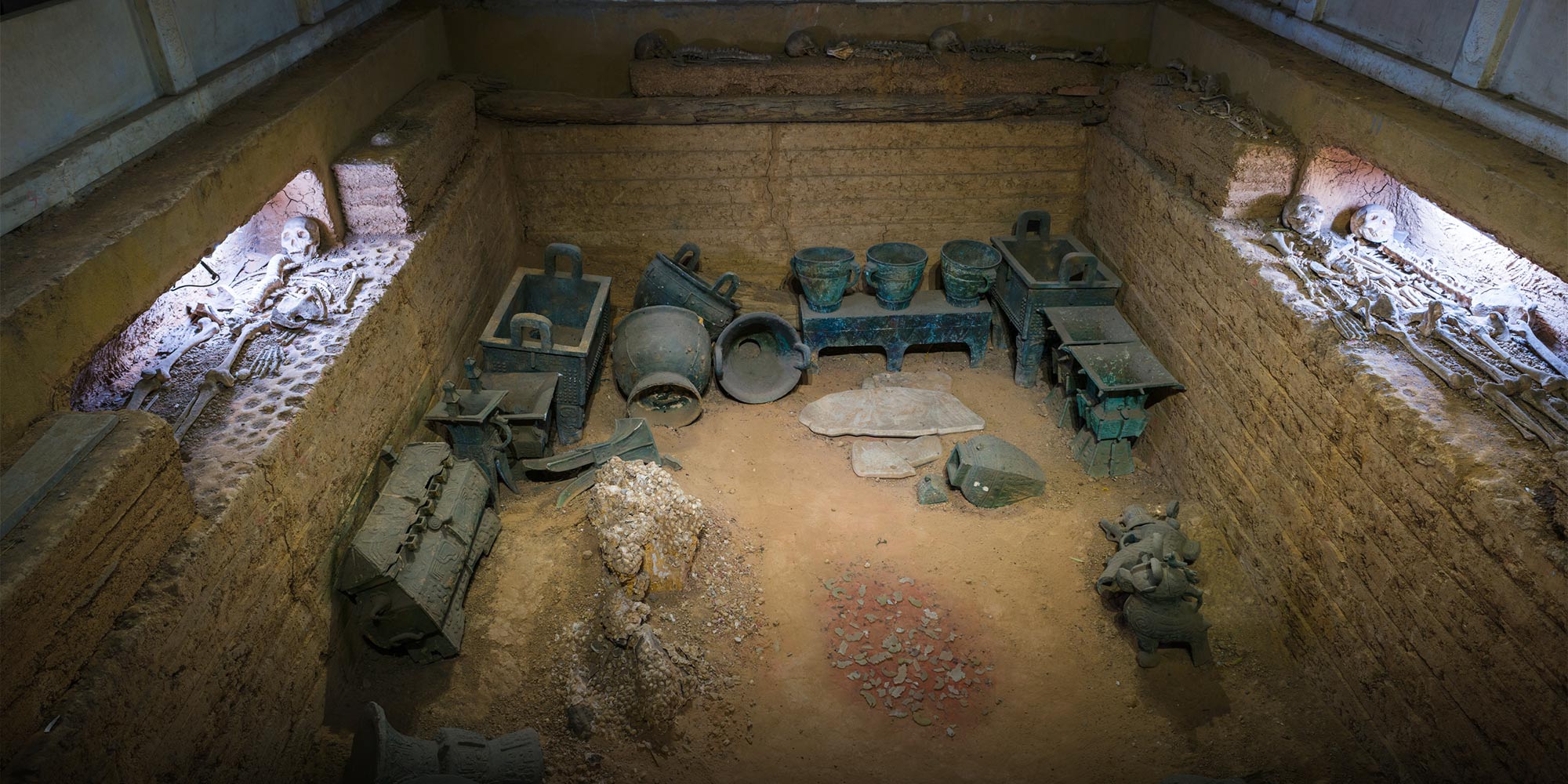
Di Xin, the last Shang king, is said to have committed suicide after his army was defeated by Wu of Zhou. “King Zhòu” became a cautionary tale on what could befall a kingdom if its ruler gave into corruption and moral depravity. He sank into megalomania and viscous cruelty, to the point where his own ministers and family members opposed him. Human sacrifices were not uncommon.
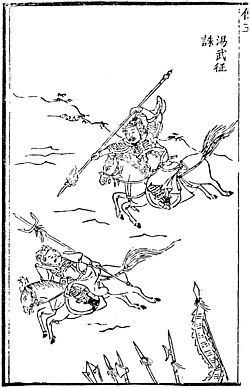
In c. 1046 BC, the army of Ji Fa of Zhou, invaded with 45,000 troops led by Jiang Ziya, compared to the Shang’s 170,000. Despite this, due to having been occupied with fighting the Renfang, they had caught the Shang unaware whilst troop morale was low. This led to a surprise defeat and subsequent suicide of Di Xin.
The Zhou kingdom was one of the kingdoms of the Shang empire. It was ruled by King Wen, born to a Shang princess.
As discontent with King Tang increased, a five planet conjuncture in 1059 BCE was interpreted as a Mandate of Heaven for ‘…King Wen of Zhou to attack Shang and take possession of the state…’
This conjecture of the planets occurs every 516 years, and also signalled the commencement of the Wei and Shang dynasties.
King Wu died 10 years after the mandate and so it was his son King Wu who launched the attack on King Tang in 1046 BCE.
Wu killed and sacrificed a large number of the Shang leadership and army. Other members of the Shang royal lineage were permitted to stay, to perform the rituals for the ancient kings.
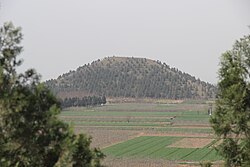
The Western Zhou state then became ascendant for about 70 years until the disastrous Zhou–Chu War in 977 BC. The Zhou court gradually declined in power and lost authority over its vassal states, which culminated in an aristocrat insurgency in 841 BC that forced King Li into exile and subsequently began a 14-year period of regency by nobles. The Zhou dynasty had a brief resurgence under King Li’s son King Xuan, who scored a series of successful campaigns against the Four Barbarians, but suffered crushing defeats against the Xirong, particularly in 789 BC against the western Shen state. To pacify the Shen state, King Xuan’s son King You married the daughter of Marquis of Shen and named their son Yijiu as the crown prince. However King You fell out with the daughter. That enraged the Marquis of Shen, who rebelled in collaboration with another state Zeng and the Quanrong barbarians and defeated King You’s royal forces at the Battle of Mount Li in 771 BC, killing King You in the process.
The Western Zhou dynasty ended in 771 BC when Quanrong mercenaries hired by the rebel Marquis of Shen sacked the Zhou capital Fenghao (which consisted of the twin cities Fengjing and Haojing).
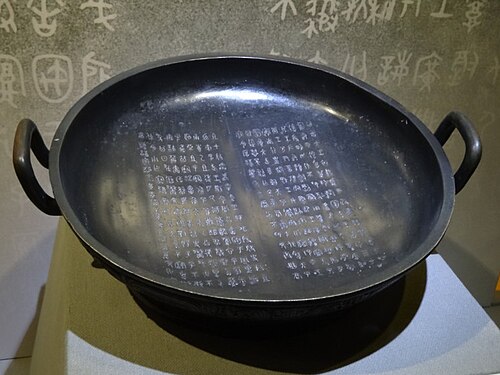
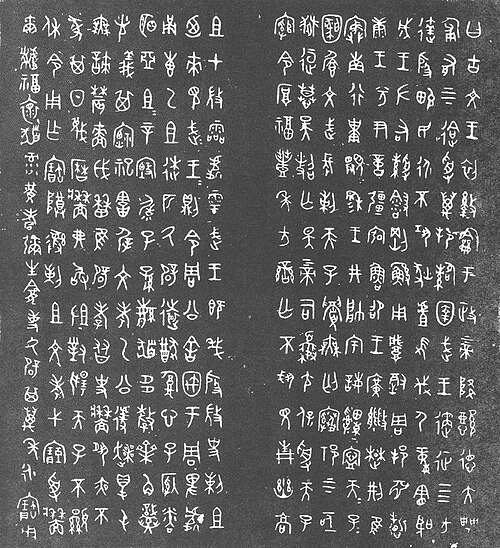
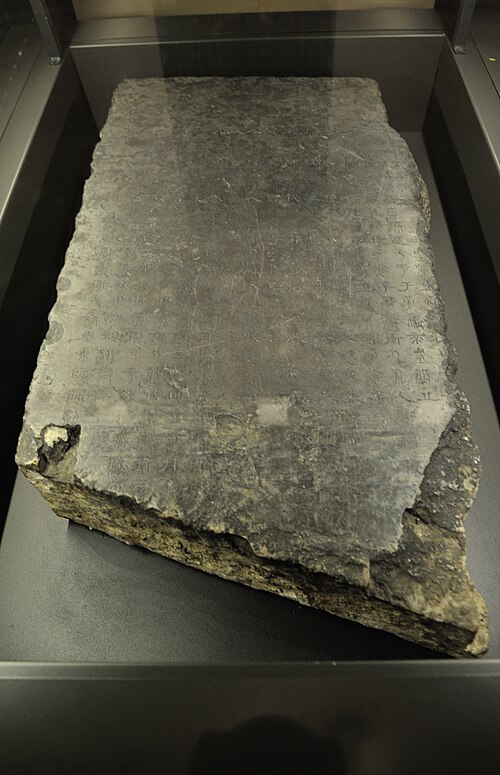
The Zhou produced thousands of inscriptions, mostly on bronze ritual vessels and often considerably longer than those of the Late Shang. Early inscriptions are quite short. The length of texts gradually increased until the middle of the Western Zhou period and remained fairly consistent thereafter. The character forms and language of these inscriptions are obscure, and their interpretation rests heavily on transmitted texts.
A vessel was typically cast for some member of the Zhou elite, recording a relevant event or an honour bestowed on the owner by the king. In the latter case, the inscription might include a narrative of the ceremony and report the speech of participants. These give a rich insight into Zhou governance and the upper levels of Zhou society.
Many inscriptions contain details that may be compared with later histories. More than a hundred of them commemorate a royal appointment to some government position. More than 50 of them describe military campaigns. Naturally the picture is incomplete, as very few inscriptions touch on military defeats or failures of government. As the Book of Rites says of these inscriptions, “The intention of the inscriber is to extol the beautiful and not to extol the ugly.”
As the capital was moved to the east it became known as the Eastern Zhou Dynasty.
The Eastern Zhou was characterised by the weakened authority of the Ji family, the Zhou royal house. It is subdivided into two parts: the Spring and Autumn period (c. 770 – c. 481 or 476 BC), during which the ancient aristocracy still held power in a large number of separate polities, and the Warring States period (c. 481 or 476 – 221 BC), which saw the consolidation of territory and escalation of interstate warfare and administrative sophistication.
The dominant material for making tools had become iron by the end of the Eastern Zhou; as such, it is considered to be the beginning of the Iron Age in China. There was a considerable development in agriculture with a consequent increase in population. There were constantly fights between vassals over land or other resources. People started using copper coins. Education was made universal for civilians. The boundaries between the nobility and the civilians subsided. A revolutionary transformation of the society was taking place, to which the patriarchal clan system made by the Zhou Dynasty could no longer adapt.
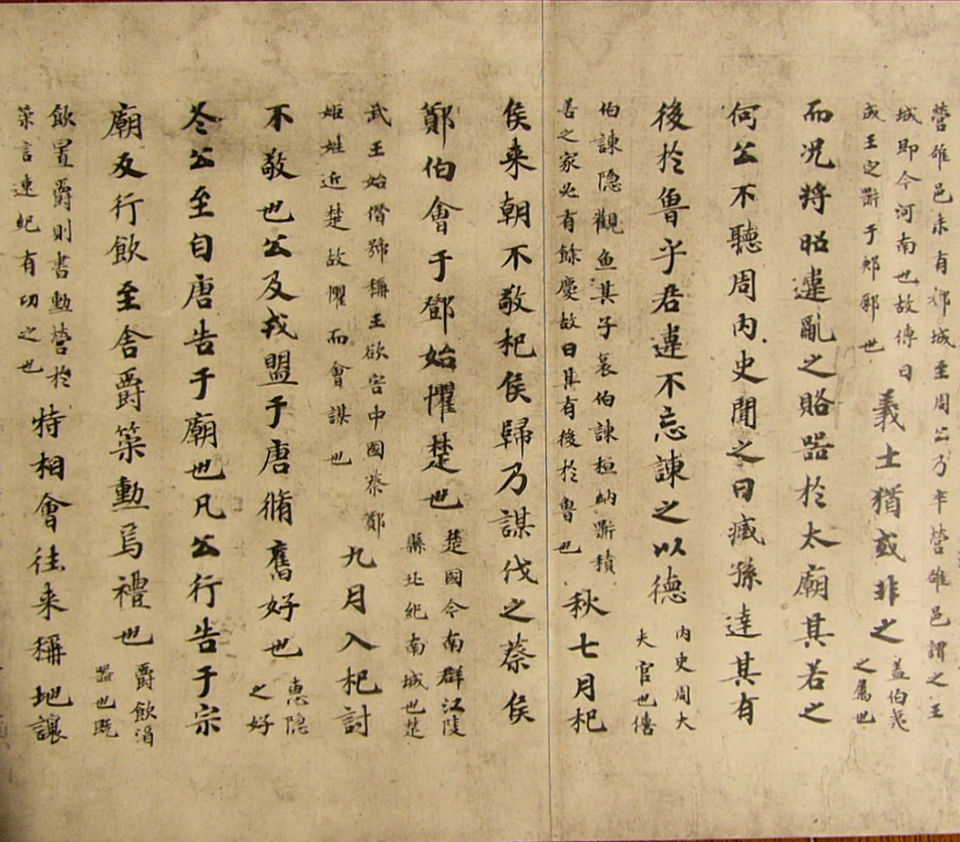
The Spring and Autumn Annals is an ancient Chinese chronicle that has been one of the core Chinese classics since ancient times. The Annals is the official chronicle of the State of Lu, and covers a 242-year period from 722 to 481 BCE. It is the earliest surviving Chinese historical text to be arranged in annals form.
The Annals records main events that occurred in Lu during each year, such as the accessions, marriages, deaths, and funerals of rulers, battles fought, sacrificial rituals observed, celestial phenomena considered ritually important, and natural disasters. The entries are tersely written, averaging only 10 characters per entry, and contain no elaboration on events or recording of speeches.
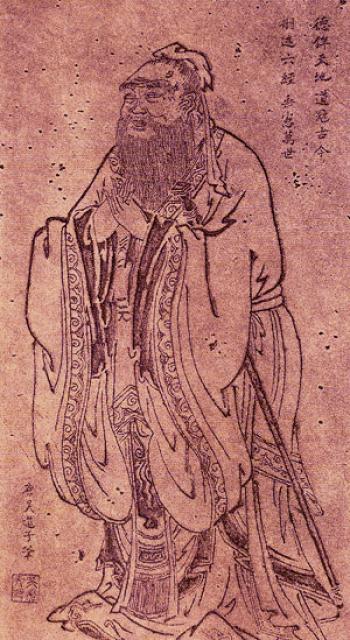
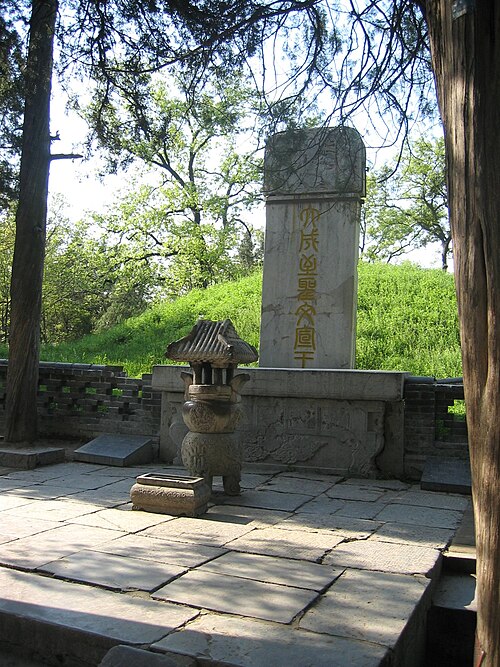
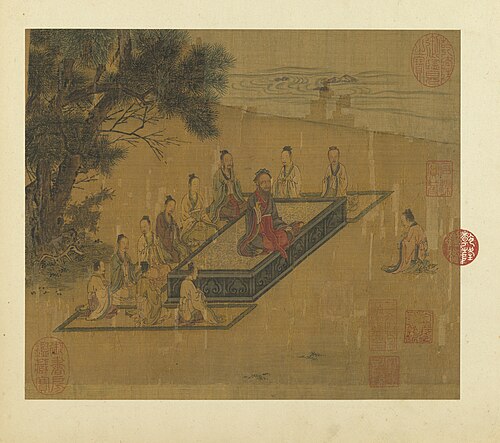
Confucius developed the enduring political philosophy based on older historical traditions and the rituals of leadership, that the sage-monarch was mandated by heaven and hence was due all allegiance.
His philosophical teachings, called Confucianism, emphasized personal and governmental morality, harmonious social relationships, righteousness, kindness, sincerity, and a ruler’s responsibilities to lead by virtue.
Confucius considered himself a transmitter for the values of earlier periods which he claimed had been abandoned in his time. He advocated for filial piety, endorsing strong family loyalty, ancestor veneration, and the respect of elders by their children and of husbands by their wives. Confucius recommended a robust family unit as the cornerstone for an ideal government. He championed the Silver Rule, or a negative form of the Golden Rule, advising, “Do not do unto others what you do not want done to yourself.”
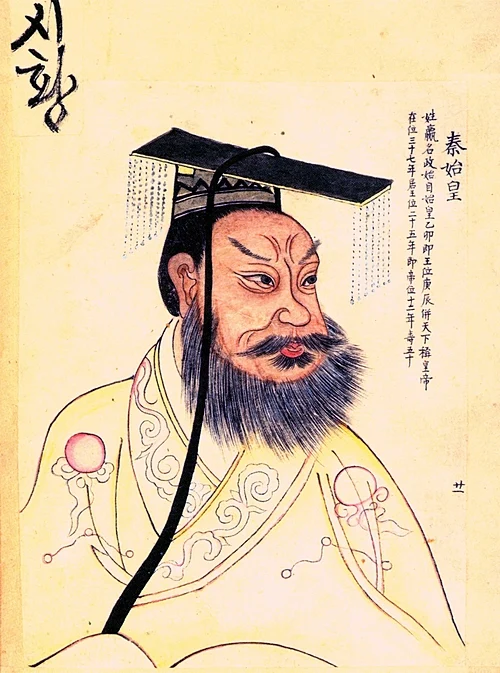
The Qin dynasty was the first imperial dynasty of China. It is named for its progenitor state of Qin, a fief of the confederal Zhou dynasty (c. 1046–256 BC). Beginning in 230 BC, the Qin under King Ying Zheng engaged in a series of wars conquering each of the rival states that had previously pledged fealty to the Zhou. This culminated in 221 BC with the successful unification of China. The Qin then assumed an imperial prerogative – with Ying Zheng declaring himself to be Qin Shi Huang, the first emperor of China, and bringing an end to the Warring States period (c. 475–221 BC). This state of affairs lasted until 206 BC, when the dynasty collapsed in the years following Qin Shi Huang’s death. The Qin dynasty’s 14-year existence was the shortest of any major dynasty in Chinese history, with only two emperors. However, the succeeding Han dynasty (202 BC – 220 AD) largely continued the military and administrative practices instituted by the Qin; as a result, the Qin have been credited as the originators of the Chinese imperial system that would endure in some form until the Xinhai Revolution in 1911.
Qin was a minor power for the first several centuries of its existence; its strength greatly increased in the 4th century BC, in large part owing to the administrative and military reforms of Shang Yang. They sought to create a strong, centralised state and a large army supported by a stable economy, which were developed in the Qin homeland and implemented across China following its unification. Reforms included the standardisation of currency, weights, measures, and the writing system, along with innovations in weaponry, transportation and military tactics.
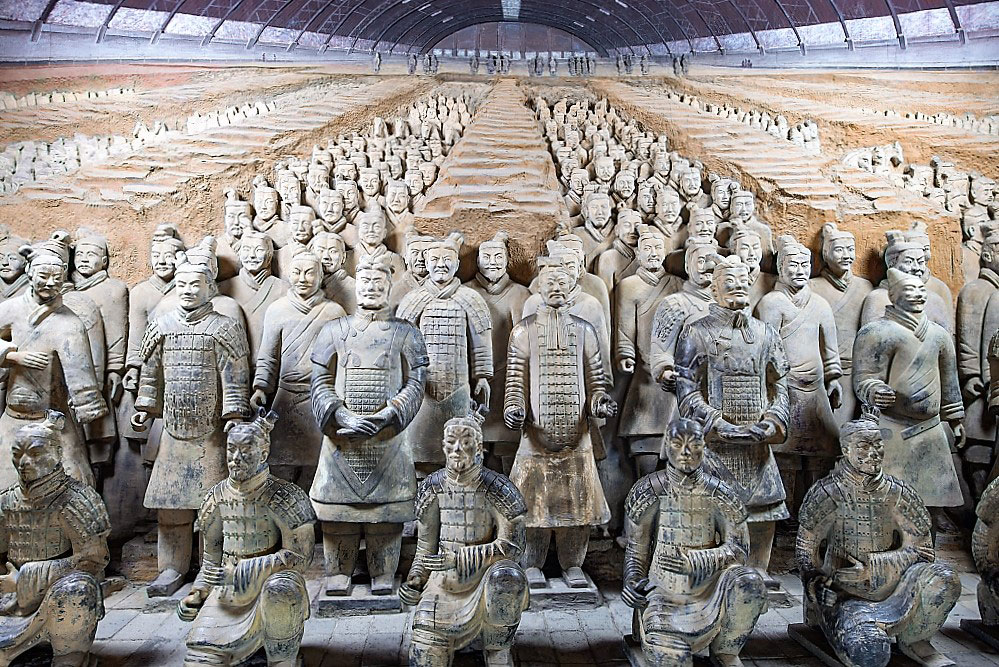
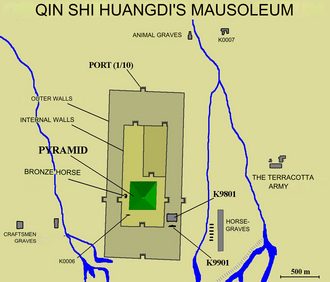
The Mausoleum of Qin Shi Huang is a tomb complex constructed for Qin Shi Huang, the first emperor of the Chinese Qin dynasty. It is located in modern-day Lintong District in Xi’an, Shaanxi. It was constructed over 38 years from 246 to 208 BC, and is situated underneath a 76-metre-tall (249 ft) tomb mound shaped like a truncated pyramid. The layout of the mausoleum is modeled on the layout of Xianyang, the capital of the Qin dynasty, which was divided into inner and outer cities. The circumference of the inner city is 2.5 km and the outer is 6.3 km. The tomb is located in the southwest of the inner city and faces east. The main tomb chamber housing the coffin and burial artefacts is the core of the architectural complex of the mausoleum.
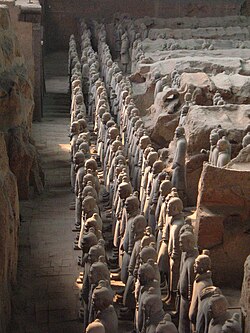
The tomb itself has not yet been excavated. Archaeological explorations currently concentrate on various sites of the extensive necropolis surrounding the tomb, including the Terracotta Army to the east of the tomb mound. The Terracotta Army served as a garrison to the mausoleum and has yet to be completely excavated.
The Qin dynasty established a strict centralised administration, standardised writing and measurements.
Training and education were important, and included strict examinations with clear expectations of the standards required.
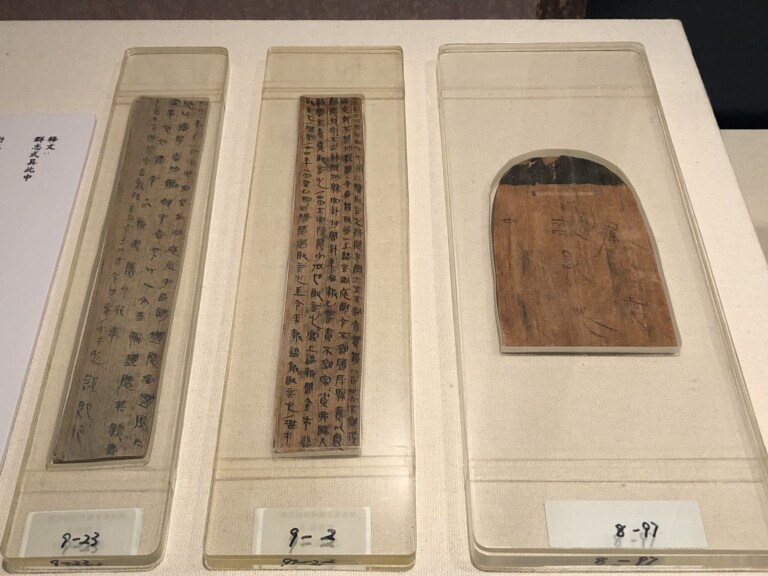
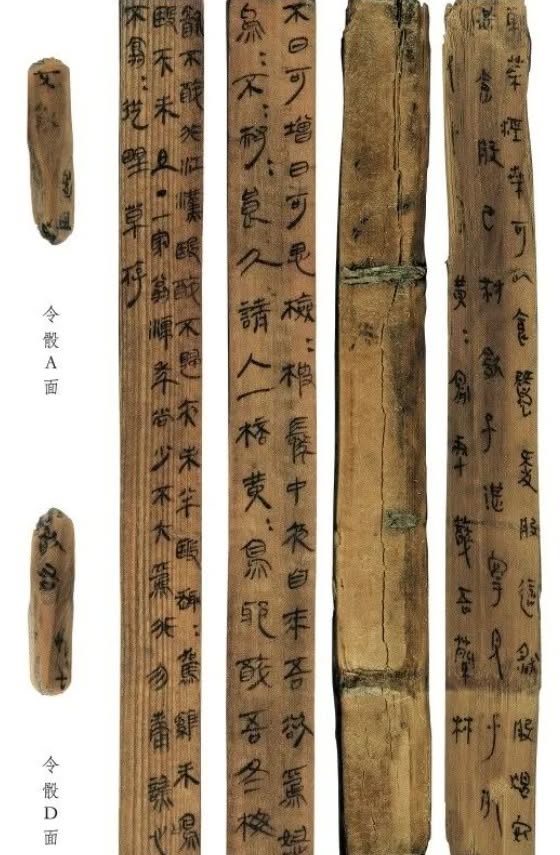
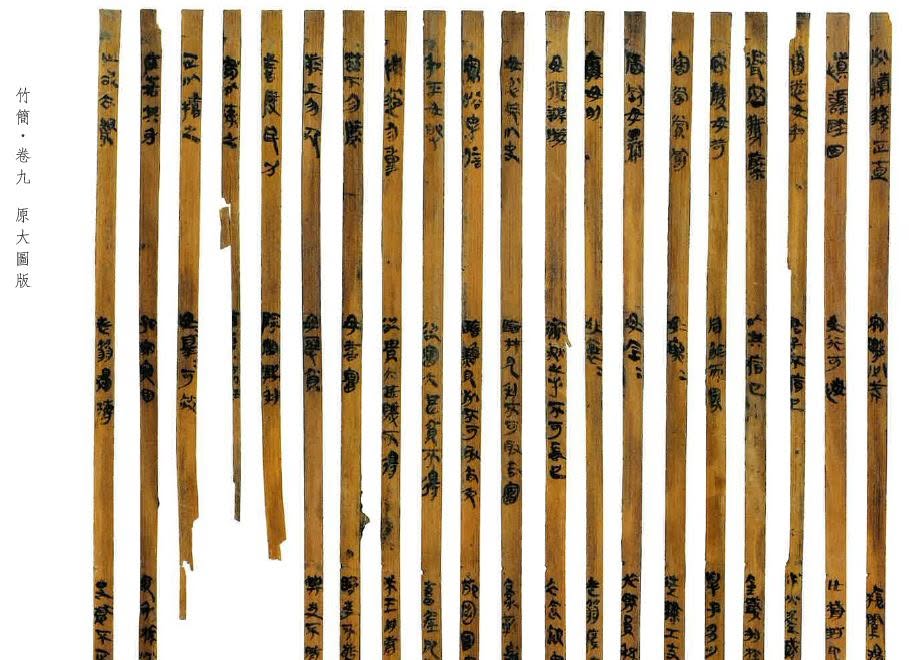
Examples of this are found on over 2,000 bamboo strips that were acquired in a Hong Kong antiques market in 2007.
They detail ‘exemplary’ legal practices showing how magistrates interviewed witnesses, listened carefully to evidence and graded punishment. The places for discretion and mercy were also covered.
An example is the case in 242 BCE of a murder in a rural cottage See opposite)
The first part of the case record is an account of the offence and the subsequent criminal investigations. The offender tied up and killed a disowned wife in a secluded field hut and stole her clothes. The case was difficult to solve, because the offender disappeared without a trace, and there was no usable evidence.
It is not documented how the judicial secretary of the prefecture who was charged with the investigation found the suspect, but it becomes clear that he applied ingenious investigating methods.
First, the suspect and all his acquaintances were confidentially questioned. Afterwards, the investigating official confronted the accused with the results of this questioning and forced him to amend his former statements. The suspect’s confession of guilt is missing in the preserved fragments, and the name of a second offender appears.
It is furthermore stressed that both offenders, who were liable to the death penalty and executed by quartering, were a great danger to society.
The second part of the case record is the actual letter of recommendation for the promotion of the investigating official. At the beginning of this letter,the ordinances forming the legal basis for recommending competent judicial secretaries to the higher authorities for promotion are quoted.
At the end of the letter the required ethical standards which predestine a judicial official for the office of a provincial secretary are emphasised. Additionally, the hope that other officials will follow his example is expressed.
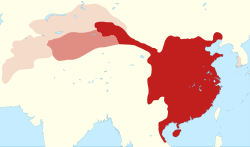
The Han dynasty (202 BC – 9 AD, 25–220 AD) was an imperial dynasty of China established by Liu Bang, and followed the short-lived Qin dynasty (221–206 BC). It was briefly interrupted by the Xin dynasty (9–23 AD). It is separated into two periods—the Western Han (202 BC – 9 AD) and the Eastern Han (25–220 AD). The Han dynasty is considered a golden age in Chinese history, impacting Chinese identity in later periods. The majority ethnic group of modern China refer to themselves as the “Han people“, while spoken Chinese and written Chinese are referred to respectively as the “Han language” and “Han characters“.
The Qin had united the Chinese Warring States by conquest, but their regime became unstable after the death of the first emperor Qin Shi Huang. Within four years, the dynasty’s authority had collapsed in a rebellion. Two former rebel leaders, Xiang Yu (d. 202 BC) of Chu and Liu Bang (d. 195 BC) of Han, engaged in a war to determine who would have hegemony over China, which had fissured into Eighteen Kingdoms, each claiming allegiance to either Xiang Yu or Liu Bang. Although Xiang Yu proved to be an effective commander, Liu Bang defeated him at the Battle of Gaixia (202 BC) in modern-day Anhui. Liu Bang assumed the title of Emperor at the urging of his followers and is known posthumously as Emperor Gaozu (r. 202–195 BC).
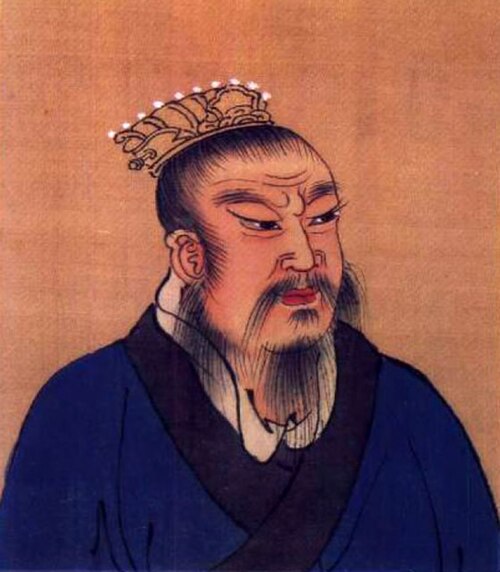
Originally a minor Qin official and rebel leader, he defeated his rival Xiang Yu and became emperor in 202 BCE. He relaxed some of the Qin Dynasty’s harsher laws and created the political foundations of Han rule.
Empress Lü Zhi
Liu Bang’s wife and one of the most powerful women in early imperial Chinese history. After his death, she dominated the court as empress dowager and controlled imperial politics through several short-lived emperors.
Emperor Wen
Remembered for restrained government, lower taxes, reduced punishments, and economic recovery. His reign helped establish the prosperous early-Han period known as the Rule of Wen and Jing.
Emperor Jing
Continued Emperor Wen’s relatively economical government and defeated the Rebellion of the Seven States, strengthening central imperial authority.
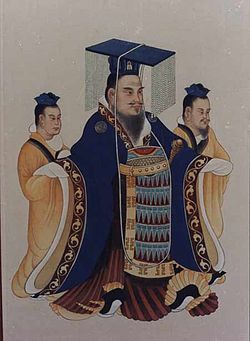
Emperor Wu, or Han Wudi
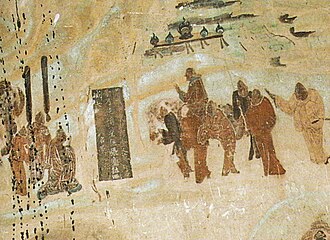
Usually considered the most important Han emperor after the founder. During his long reign, from 141 to 87 BCE, the empire expanded into Central Asia, Korea, southern China, and northern Vietnam. His government promoted Confucian learning, strengthened central administration, and supported missions that helped establish Silk Road connections.
Unlike the emperors before him, the young and vigorous Emperor Wu was unwilling to put up with the status quo. Only a year into his reign in late 141 BC, Emperor Wu took the advice of Confucian scholars and launched an ambitious reform, known in history as the Jianyuan Reforms
Wang Mang
A court official who seized the throne and established the short-lived Xin Dynasty in 9 CE. His ambitious land and monetary reforms largely failed, rebellion spread, and he was killed in 23 CE.
Liu Xiu, Emperor Guangwu
Restored the Han Dynasty in 25 CE after Wang Mang’s fall. He founded the Eastern Han, moved the capital to Luoyang, and rebuilt imperial government after years of warfare.
Han Xin
One of Liu Bang’s greatest generals. His campaigns were crucial in defeating rival kingdoms and winning the Chu–Han struggle. Brilliant on the battlefield, he later became politically suspect and was executed.
Zhang Liang
A strategist and adviser to Liu Bang. He helped shape the plans, alliances, and political manoeuvres that enabled Liu Bang to defeat Xiang Yu.
Xiao He
Liu Bang’s chief administrator. While the armies fought, Xiao He organised taxation, supplies, records, and government, providing the machinery that kept the new regime alive.
Wei Qing
A leading general under Emperor Wu who won major victories against the Xiongnu, the powerful confederation north of China.
Huo Qubing
Wei Qing’s nephew and an exceptionally successful young cavalry commander. He led rapid campaigns deep into Xiongnu territory before dying at about 23 or 24.
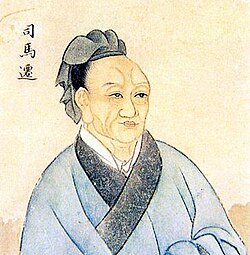
Sima Qian (c. 145 BC – c. 86 BC) was a Chinese historian during the early Han dynasty. He is considered the father of Chinese historiography for the Shiji (sometimes translated into English as Records of the Grand Historian), a general history of China covering more than two thousand years from the rise of the legendary Yellow Emperor and formation of the first Chinese polity to the reign of Emperor Wu of Han, during which Sima wrote. As the first universal history of the world as it was known to the ancient Chinese, the Shiji served as a model for official histories for subsequent dynasties across the Sinosphere until the 20th century.[1]
Sima Qian’s father, Sima Tan, first conceived of the ambitious project of writing a complete history of China, but had completed only some preparatory sketches at the time of his death. After inheriting his father’s position as court historian in the imperial court, he was determined to fulfill his father’s dying wish of composing and putting together this epic work of history.
However, in 99 BC, he would fall victim to the Li Ling affair for speaking out in defense of the general, who was blamed for an unsuccessful campaign against the Xiongnu. Given the choice of being executed or castrated, he chose the latter in order to finish his historical work. Although he is universally remembered for the Records, surviving works indicate that he was also a gifted poet and prose writer, and he was instrumental in the creation of the Taichu calendar, which was officially promulgated in 104 BC.
Sima was acutely aware of the importance of his work to posterity and its relationship to his own personal suffering. In the postface of the Records, he implicitly compared his universal history of China to the classics of his day, the Guoyu by Zuo Qiuming, “Li Sao” by Qu Yuan, and the Art of War by Sun Bin, pointing out that their authors all suffered great personal misfortunes before their lasting monumental works could come to fruition.

Emperor Wu
Emperor Wu of Han, born Liu Che, ruled China from 141 to 87 BCE and transformed the Han dynasty into an expansionist empire. Ascending the throne as a teenager, he strengthened imperial authority, reduced the influence of regional kings, and promoted Confucian learning as the ideological foundation of government. He established institutions for training officials and relied on talented advisers, although his court could also be harsh and politically dangerous.
Wu’s reign was marked by major military campaigns. Han armies pushed the Xiongnu northward, expanded into Korea, southern China, and Central Asia, and secured routes that later became part of the Silk Road. These victories increased China’s prestige and opened trade, but they were extraordinarily expensive. To finance warfare and state projects, the government imposed heavier taxes, monopolised salt and iron, controlled coinage, and placed greater burdens on peasants and merchants.
In his later years, Emperor Wu became increasingly suspicious, authoritarian, and preoccupied with immortality. Court rivalries and accusations of witchcraft led to purges, executions, and the tragic rebellion and death of his crown prince, Liu Ju, in 91 BCE. These events damaged the royal family and public confidence.
The “downfall” of Emperor Wu was not a sudden overthrow, but a decline in judgement, stability, and popular support. Near the end of his reign, he acknowledged some mistakes and reduced military expansion through the Repenting Edict of Luntai. He died in 87 BCE, leaving an enlarged empire, but also financial strain, social suffering, and political wounds that troubled his successors.
Decline of the Han Dynasty
After 92 AD, palace eunuchs increasingly involved themselves in the dynasty’s court politics, engaging in violent power struggles between various consort clans of the empresses and empresses dowager. Imperial authority was also seriously challenged by large Taoist religious societies which instigated the Yellow Turban Rebellion and the Five Pecks of Rice Rebellion. Following the death of Emperor Ling (r. 168–189 AD), the palace eunuchs were massacred by military officers, allowing members of the aristocracy and military governors to become warlords and divide the empire. The Han dynasty came to an end in 220 AD when Cao Pi, king of Wei, usurped the throne from Emperor Xian.
The Three Kingdoms of Cao Wei, Shu Han, and Eastern Wu dominated China from 220 to 280 AD following the end of the Han dynasty.[1] This period was preceded by the Eastern Han dynasty and was followed by the Western Jin dynasty. Academically, the periodisation begins with the establishment of Cao Wei in 220 AD and ends with the conquest of Wu by Jin in 280 AD. The period immediately preceding the Three Kingdoms, from 184 to 220 AD, was marked by chaotic infighting among warlords across China as Han authority collapsed. The period from 220 to 263 AD was marked by a comparatively stable arrangement between Cao Wei, Shu Han, and Eastern Wu. This stability broke down with the conquest of Shu by Wei in 263 AD, followed by the usurpation of Cao Wei by Jin in 266 AD and ultimately the conquest of Wu by Jin in 280 AD.
The Three Kingdoms period which included the collapse of the Han was one of the most dangerous periods in Chinese history due to multiple plagues, widespread famines, and civil war. A nationwide census taken in 280 AD, following the reunification of the Three Kingdoms under the Jin showed a total of 2,459,840 households and 16,163,863 individuals which was only a fraction of the 10,677,960 households, and 56,486,856 individuals reported during the Han era.[2] While the census may not have been particularly accurate due to a multitude of factors of the times, in 280 AD, the Jin did make an attempt to account for all individuals where they could.[3]
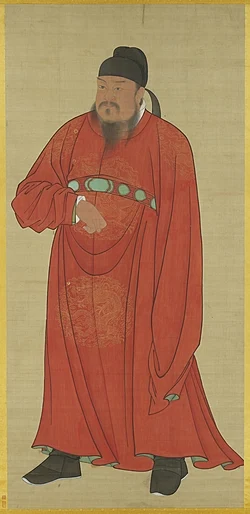
The Tang dynasty was an imperial dynasty of China that ruled from 618 to 907, with an interregnum between 690 and 705. It was preceded by the Sui dynasty and followed by the Five Dynasties and Ten Kingdoms period. Historians generally regard the Tang as a high point of Chinese civilisation, and a golden age of cosmopolitan culture. Tang territory, acquired through the military campaigns of its early rulers, surpassed that of the Han dynasty.
The Li family founded the dynasty after taking advantage of a period of Sui decline and precipitating their final collapse, in turn inaugurating a period of progress and stability in the first half of the dynasty’s rule. The dynasty was formally interrupted from 690 to 705 when Empress Wu Zetian seized the throne, proclaiming the Wu Zhou dynasty and becoming the only legitimate Chinese female emperor. The An Lushan rebellion (755–763) led to devastation and the decline of central authority during the latter half of the dynasty.It incurred a death toll of about 16 to 30 million people – similar to that of World War 1. Even though the rebellion eventually failed, it was an important turning point in the history of medieval China, as the military activities and associated casualties caused significant depopulation from famine, displacement, and large-scale infrastructure destruction, significantly weakening the Tang dynasty and leading to the permanent loss of the Western Regions.
The Tang maintained a civil-service system by recruiting scholar-officials through standardised examinations and recommendations to office. The rise of regional military governors known as jiedushi during the 9th century undermined this civil order. The dynasty and central government went into decline by the latter half of the 9th century; agrarian rebellions resulted in mass population loss and displacement, widespread poverty, and further government dysfunction that ultimately ended the dynasty in 907.
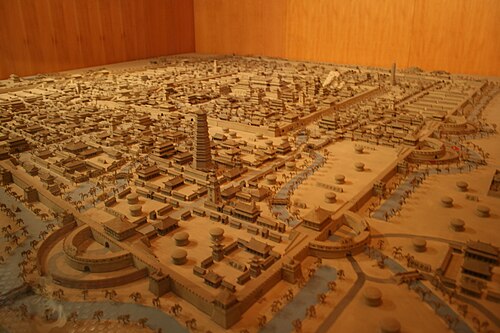
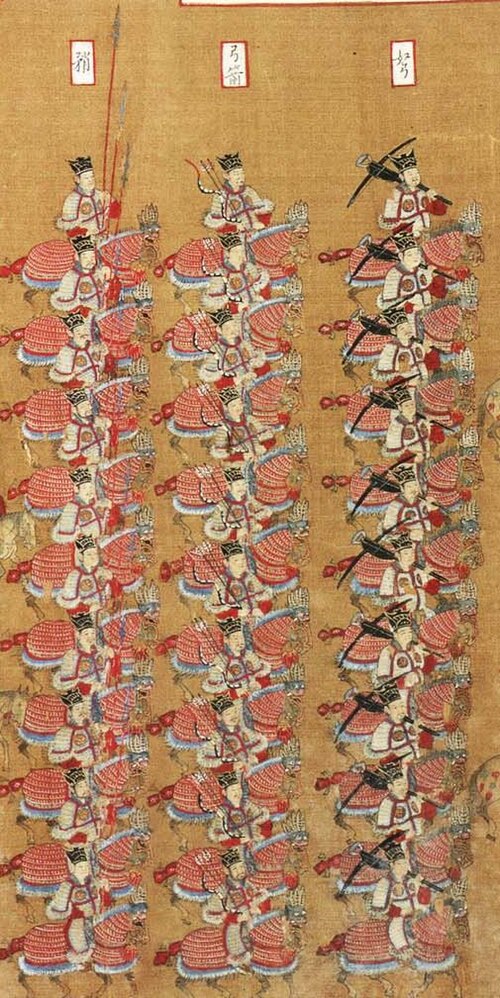
The Tang capital at Chang’an (present-day Xi’an) was the world’s most populous city for much of the dynasty’s existence. Two censuses of the 7th and 8th centuries estimated the empire’s population at about 50 million people, which grew to an estimated 80 million by the dynasty’s end. The dynasty raised professional and conscripted armies of hundreds of thousands of troops to contend with nomadic powers for control of Inner Asia and the lucrative trade-routes along the Silk Road. Far-flung kingdoms and states paid tribute to the Tang court, while the Tang also indirectly controlled several regions through a protectorate system. In addition to its political hegemony, the Tang exerted a powerful cultural influence over neighbouring East Asian nations such as Japan and Korea.
Chinese culture flourished and further matured during the Tang era. It is traditionally considered the greatest age for Chinese poetry.[12] Two of China’s most famous poets, Li Bai and Du Fu, belonged to this age, contributing with poets such as Wang Wei to the monumental Three Hundred Tang Poems. Many famous painters such as Han Gan, Zhang Xuan, and Zhou Fang were active, while Chinese court music flourished with instruments such as the popular pipa. Tang scholars compiled a rich variety of historical literature, as well as encyclopaedias and geographical works. Notable innovations included the development of woodblock printing. Buddhism became a major influence in Chinese culture, with native Chinese sects gaining prominence. However, in the 840s, Emperor Wuzong enacted policies to suppress Buddhism, which subsequently declined in influence.
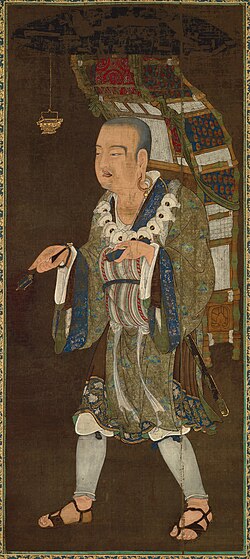
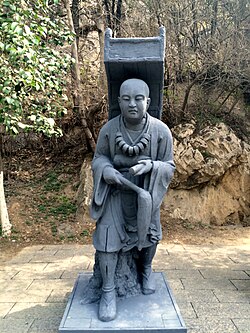
Xuanzang (6 April 602 – 5 February 664), born Chen Hui or Chen Yi , was a 7th-century Chinese Buddhist monk, scholar, traveller, and translator. He is known for the epoch-making contributions to Chinese Buddhism, the travelogue of his journey to the Indian subcontinent in 629–645, his efforts to bring at least 657 Indian texts to China, and his translations of some of these texts.[2] He was only able to translate 75 distinct sections of a total of 1,335 chapters, but his translations included some of the most important Mahayana scriptures.[1]
At age 27, he began his seventeen-year overland journey to India. He defied his nation’s ban on travel abroad, making his way through central Asian cities such as Khotan to India. He visited, among other places, the famed Nalanda University in modern day Bihar, India, where he studied with the monk Śīlabhadra. He departed from India with numerous Sanskrit texts on a caravan of twenty packhorses. His return was welcomed by Emperor Taizong in China, who encouraged him to write a travelogue.[2]
This Chinese travelogue, titled the Records of the Western Regions, is a notable source about Xuanzang, and also for scholarship on 7th-century India and Central Asia.[4] His travelogue is a mix of the implausible, the hearsay and a firsthand account.[5] Selections from it are used, and disputed,[6] as a terminus ante quem of 645 for events, names and texts he mentions. His text in turn provided the inspiration for the novel Journey to the West written by Wu Cheng’en during the Ming dynasty, around nine centuries after Xuanzang’s death.[7]
The Five Dynasties and Ten Kingdoms Period (Chinese: 五代十國) was an era of political upheaval and division in Imperial China from 907 to 979 CE. Five dynastic states quickly succeeded one another in the Central Plain, and more than a dozen concurrent dynastic states, of which the most powerful and influential ten were known as the ten kingdoms, were established elsewhere, mainly in South China. It was a prolonged period of multiple political divisions in Chinese imperial history.[1]
Traditionally, the era is seen as beginning with the fall of the Tang dynasty in 907 and reaching its climax with the founding of the Song dynasty in 960. In the following 19 years, Song gradually subdued the remaining states in South China, but the Liao dynasty still remained in China’s north (eventually succeeded by the Jin dynasty), and the Western Xia was eventually established in China’s northwest.
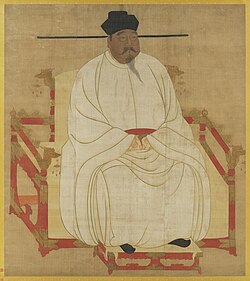
The Song dynasty was an imperial dynasty of China that ruled from 960 to 1279. The dynasty was founded by Emperor Taizu of Song, who usurped the throne of the Later Zhou dynasty and went on to conquer the rest of the Ten Kingdoms, ending the Five Dynasties and Ten Kingdoms period. The Song often came into conflict with the contemporaneous Liao, Western Xia, and Jin dynasties in northern China. After retreating to southern China following attacks by the Jin dynasty, the Song was eventually conquered by the Mongol-led Yuan dynasty.
Technology, science, philosophy, mathematics, and engineering flourished during the Song era. The Song dynasty was the first in world history to issue banknotes or true paper money and the first Chinese government to establish a permanent standing navy. This dynasty saw the first surviving records of the chemical formula for gunpowder, the invention of gunpowder weapons such as fire arrows, bombs, and the fire lance. It also saw the first discernment of true north using a compass, first recorded description of the pound lock, and improved designs of astronomical clocks. Economically, the Song dynasty was unparalleled with a gross domestic product three times larger than that of Europe during the 12th century.[8][9] China’s population doubled in size between the 10th and 11th centuries. This growth was made possible by expanded rice cultivation, use of early-ripening rice from Southeast and South Asia, and production of widespread food surpluses.[10][11] The Northern Song census recorded 20 million households, double that of the Han and Tang dynasties. It is estimated that the Northern Song had a population of 90 million people,[12] and 200 million by the time of the Ming dynasty.[clarification needed][13] This dramatic increase of population fomented an economic revolution in pre-modern China.
After usurping the throne of the Later Zhou dynasty, Emperor Taizu of Song (r. 960–976) spent sixteen years conquering the rest of China proper, reuniting much of the territory that had once belonged to the Han and Tang empires and ending the upheaval of the Five Dynasties and Ten Kingdoms period.[1] In Kaifeng, he established a strong central government over the empire. The establishment of this capital marked the start of the Northern Song period. He ensured administrative stability by promoting the civil service examination system of drafting state bureaucrats by skill and merit (instead of aristocratic or military position) and promoted projects that ensured efficiency in communication throughout the empire. In one such project, cartographers created detailed maps of each province and city that were then collected in a large atlas.[14] Emperor Taizu also promoted groundbreaking scientific and technological innovations by supporting works like the astronomical clock tower designed and built by the engineer Zhang Sixun.[15]
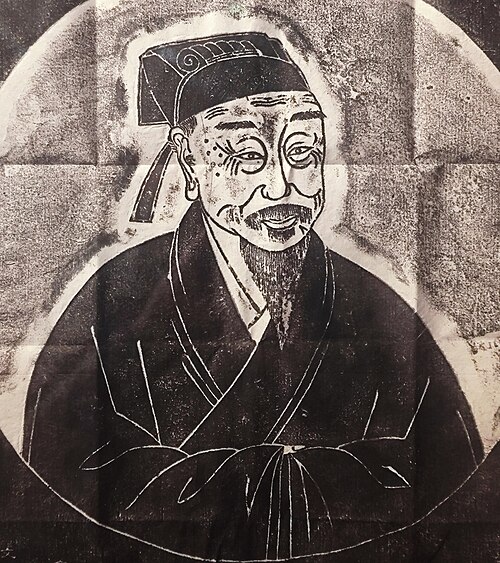
Zhu Xi (October 18, 1130 – April 23, 1200), formerly romanized Chu Hsi, was a Chinese philosopher, historian, politician, poet, and calligrapher of the Southern Song dynasty. As a leading figure in the development of Neo-Confucianism, Zhu Xi played a pivotal role in shaping the intellectual foundations of later imperial China. He sought to integrate moral self-cultivation, classical interpretation, ritual practice, and cosmological theory into a coherent framework, emphasizing disciplined study and ethical cultivation while criticizing approaches—particularly within contemporary Buddhist traditions—that claimed immediate insight detached from ritual, learning, and moral practice. His extensive commentaries and editorial work on the Four Books became the core texts of the imperial civil service examinations from 1313 until their abolition in 1905. He advanced a rigorous philosophical methodology known as the “investigation of things” and emphasized meditation as an essential practice for moral and intellectual self-cultivation. Zhu Xi’s thought exerted profound influence, becoming the official state ideology of China from the Yuan dynasty onward, and was later adopted in other East Asian countries such as Japan, Korea, and Vietnam. In these regions, his Neo-Confucian doctrines were institutionalized through educational systems and civil service examinations, shaping political ideologies, social hierarchies, and cultural values for centuries.
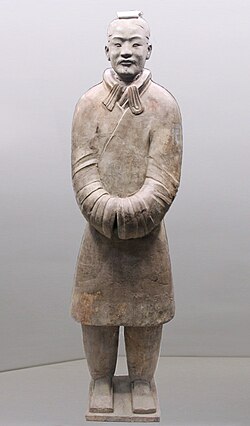
Zhu was a scholar with a wide learning in the classics, commentaries, histories and other writings of his predecessors. In his lifetime, he was able to serve multiple times as a government official, although he avoided public office for most of his adult life. He also wrote, compiled and edited almost a hundred books and corresponded with dozens of other scholars. He acted as a teacher to groups of students, many of whom chose to study under him for years. He built upon the teachings of the Cheng brothers and others, further developing their metaphysical theories in regards to Li (Forma) and Qi (Materia). His followers recorded thousands of his conversations in writing.
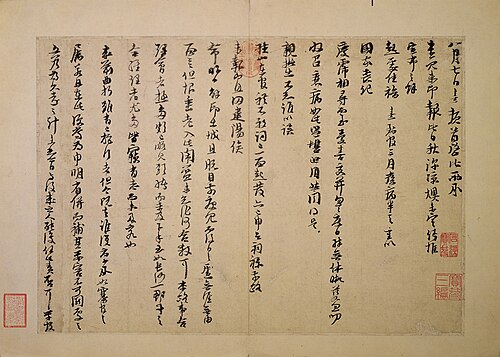
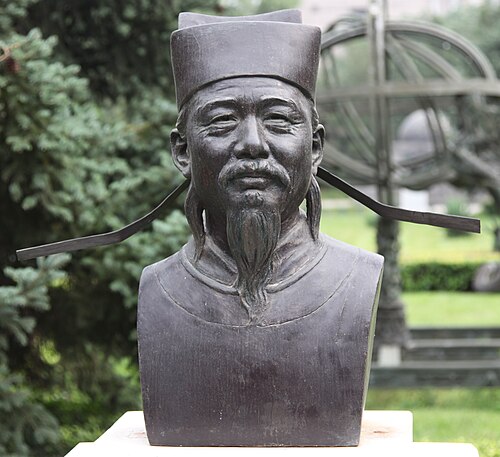
Shen Kuo (1031 – 1095) was a Chinese polymath, scientist, and statesman of the Northern Song dynasty. Shen was a master in many fields of study including mathematics, optics, and horology. In his career as a civil servant, he became a finance minister, governmental state inspector, head official for the Bureau of Astronomy in the Song court, Assistant Minister of Imperial Hospitality, and also served as an academic chancellor. At court his political allegiance was to the Reformist faction known as the New Policies Group, headed by Chancellor Wang Anshi (1021–1085).
In his Dream Pool Essays or Dream Torrent Essays of 1088, Shen was the first to describe the magnetic needle compass, which would be used for navigation (first described in Europe by Alexander Neckam in 1187). Shen discovered the concept of true north in terms of magnetic declination towards the north pole,[5] with experimentation of suspended magnetic needles and “the improved meridian determined by Shen’s [astronomical] measurement of the distance between the pole star and true north”. This was the decisive step in human history to make compasses more useful for navigation, and may have been a concept unknown in Europe for another four hundred years (evidence of German sundials made circa 1450 show markings similar to Chinese geomancers‘ compasses in regard to declination).
Alongside his colleague Wei Pu, Shen planned to map the orbital paths of the Moon and the planets in an intensive five-year project involving daily observations, yet this was thwarted by political opponents at court. To aid his work in astronomy, Shen Kuo made improved designs of the armillary sphere, gnomon, sighting tube, and invented a new type of inflow water clock. Shen Kuo devised a geological hypothesis for land formation (geomorphology), based upon findings of inland marine fossils, knowledge of soil erosion, and the deposition of silt. He also proposed a hypothesis of gradual climate change, after observing ancient petrified bamboos that were preserved underground in a dry northern habitat that would not support bamboo growth in his time. He was the first literary figure in China to mention the use of the drydock to repair boats suspended out of water, and also wrote of the effectiveness of the relatively new invention of the canal pound lock. Although not the first to invent camera obscura, Shen noted the relation of the focal point of a concave mirror and that of the pinhole. Shen wrote extensively about movable type printing invented by Bi Sheng (990–1051), and because of his written works the legacy of Bi Sheng and the modern understanding of the earliest movable type has been handed down to later generations. Following an old tradition in China, Shen created a raised-relief map while inspecting borderlands. His description of an ancient crossbow mechanism he unearthed as an amateur archaeologist proved to be a Jacob’s staff, a surveying tool which was not known in Europe until described by Levi ben Gerson in 1321.
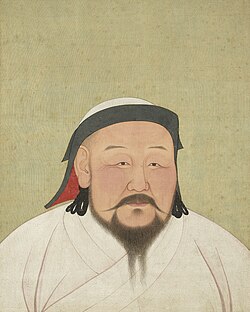
The Yuan dynasty, officially the Great Yuan, was a Mongol-led imperial dynasty of China and a successor state to the Mongol Empire after its division. It was established by Kublai (Emperor Shizu or Setsen) Khan, the fifth khagan-emperor of the Mongol Empire from the Borjigin clan, and lasted from 1271 to 1368 AD. In Chinese history, the Yuan dynasty followed the Song dynasty and preceded the Ming dynasty.
Kublai Kahn was the great grandson of Genghis Kahn.
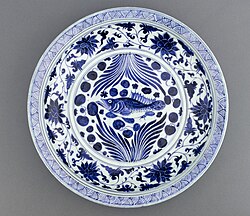
A rich cultural diversity developed during the Yuan dynasty. The major cultural achievements were the development of drama and the novel and the increased use of the written vernacular. Arts and culture also greatly developed and flourished during the Yuan dynasty. There was a widespread introduction of blue and white painted porcelain, as well as a major change to Chinese painting. The political unity of China and much of central Asia promoted trade between East and West. The Mongols’ extensive West Asian and European contacts produced a fair amount of cultural exchange. The other cultures and peoples in the Mongol Empire also very much influenced China. It had significantly eased trade and commerce across Asia until its decline; the communications between Yuan dynasty and its ally and subordinate in Persia, the Ilkhanate, encouraged this development. Buddhism had a great influence in the Yuan government, and the Tibetan-rite Tantric Buddhism had significantly influenced China during this period. The Muslims of the Yuan dynasty introduced Middle Eastern cartography, astronomy, medicine, clothing, and cuisine in East Asia. Eastern crops such as carrots, turnips, new varieties of lemons, eggplants, and melons, high-quality granulated sugar, and cotton were all either introduced or successfully popularized during the Yuan dynasty.
Kublai Khan promoted commercial, scientific, and cultural growth. He supported the merchants of the Silk Road trade network by protecting the Mongol postal system, constructing infrastructure, providing loans that financed trade caravans, and encouraging the circulation of paper jiaochao banknotes. During the beginning of the Yuan dynasty, the Mongols continued issuing coins; however, under Külüg Khan coins were completely replaced by paper money. It was not until the reign of Toghon Temür that the government of the Yuan dynasty would attempt to reintroduce copper coinage for circulation.[74] The Pax Mongolica, Mongol peace, enabled the spread of technologies, commodities, and culture between China and the West.[75] Kublai expanded the Grand Canal from southern China to Daidu in the north.[76] Mongol rule was cosmopolitan under Kublai Khan.[77] He welcomed foreign visitors to his court, such as the Venetian merchant Marco Polo, who wrote the most influential European account of Yuan China.[78] Marco Polo’s travels would later inspire many others like Christopher Columbus to chart a passage to the Far East in search of its legendary wealth.[79]
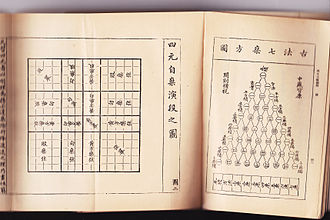
Advances in polynomial algebra were made by mathematicians during the Yuan era. The mathematician Zhu Shijie (1249–1314) solved simultaneous equations with up to four unknowns using a rectangular array of coefficients, equivalent to modern matrices. Zhu used a method of elimination to reduce the simultaneous equations to a single equation with only one unknown. His method is described in the Jade Mirror of the Four Unknowns, written in 1303. The opening pages contain a diagram of Pascal’s triangle. The summation of a finite arithmetic series is also covered in the book.
The final years of the Yuan dynasty were marked by struggle, famine, and bitterness among the populace. In time, Kublai Khan’s successors lost all influence on other Mongol lands across Asia, while the Mongols beyond the Middle Kingdom saw them as too Chinese. Gradually, they lost influence in China as well. The reigns of the later Yuan emperors were short and marked by intrigues and rivalries. Uninterested in administration, they were separated from both the army and the populace, and China was torn by dissension and unrest. Outlaws ravaged the country without interference from the weakening Yuan armies.
From the late 1340s onwards, people in the countryside suffered from frequent natural disasters such as droughts, floods and the resulting famines, and the government’s lack of effective policy led to a loss of popular support. In 1351, the Red Turban Rebellion led by Song loyalists started and grew into a nationwide uprising and the Song loyalists established a renewed Song dynasty in 1351 with its capital at Kaifeng. In 1354, when Toghtogha led a large army to crush the Red Turban rebels, Toghon Temür suddenly dismissed him for fear of betrayal. This resulted in Toghon Temür’s restoration of power on the one hand and a rapid weakening of the central government on the other. He had no choice but to rely on local warlords’ military power, and gradually lost his interest in politics and ceased to intervene in political struggles. He fled north to Shangdu from Khanbaliq (present-day Beijing) in 1368 after the approach of the forces of the Ming dynasty (1368–1644), founded by Zhu Yuanzhang in the south.